
Karan Johar’s Dharma Productions Enters Malayalam Cinema with ‘Odiyan’

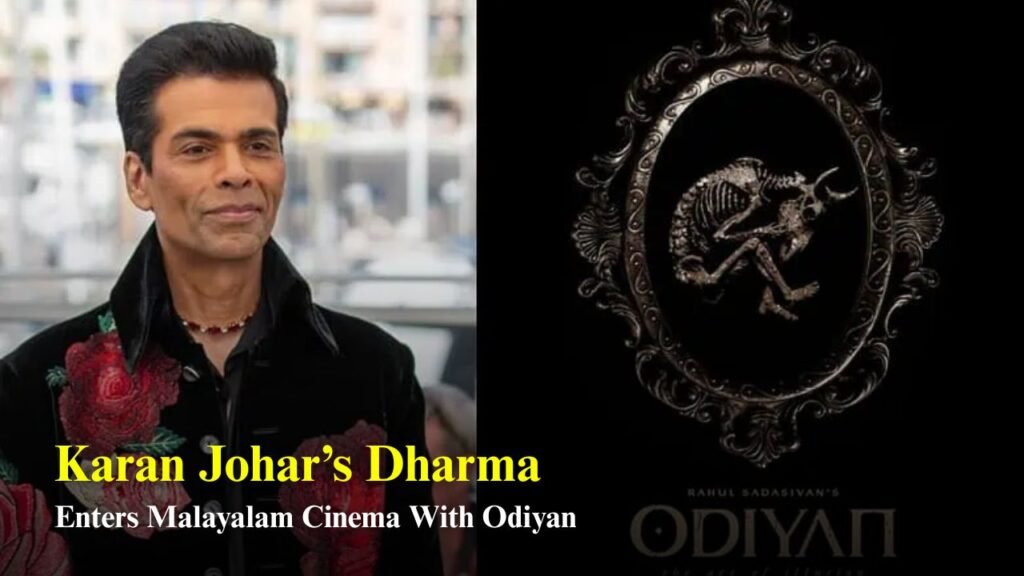
Karan Johar: Dharma Productions stepping into Malayalam cinema with Odiyan: The Age of Illusion feels less like a routine announcement and more like a quiet door opening inside Indian cinema. Dharma has long been associated with Hindi film glamour, urban emotions and star-led spectacle. Malayalam cinema, meanwhile, has earned respect through sharp writing, rooted worlds, fearless experimentation. That is why this move carries curiosity, real cultural weight and promise. The project brings together Dharma Productions and Prithviraj Productions, with Karan Johar, Adar Poonawalla, Apoorva Mehta and Supriya Menon attached as producers. Directed by Rahul Sadasivan and starring Prithviraj Sukumaran and Manju Warrier, it sounds like a meeting point between reach and restraint, myth and market.

Why Dharma’s Malayalam Debut Feels Bigger Than One Film
There is a reason this announcement has travelled fast beyond Malayalam film circles. Dharma is not simply entering another regional market; it is entering a space that commands serious respect. Malayalam films have shown that intimate atmospheres and culturally specific stories can still travel widely. By choosing Odiyan, Dharma appears to be avoiding a safe crossover and walking into folklore, darkness and psychological mystery. That choice matters. It suggests that the studio is not treating Malayalam cinema as a language label, but as a storytelling culture with its own rhythms. If handled with care, this could become a model where scale supports authenticity.

The Folklore Hook: Why Odiyan Already Feels Suspenseful
The word Odiyan carries mystery because it belongs to stories in Kerala. The figure is often imagined as a shape-shifter, someone moving between fear, belief and deception. In this new film, the idea reportedly connects with a powerful matriarchal household and a battle between truth and illusion. For readers tracking the creative stakes, the intrigue is clear:

- The story is rooted in Kerala’s cultural memory, not borrowed fantasy decoration.
- The title invites fear because the monster may be physical, psychological, social or all three.
- The presence of a matriarchal household hints at family power, inherited secrets and moral conflict.
- Rahul Sadasivan’s style suggests atmosphere may matter as much as plot twists.
This is where Odiyan can become more than another pan-India announcement. Folklore works best when it feels local enough to smell the soil and universal enough to disturb anyone. Malayalam cinema has often understood that fear does not always need loud background music. Sometimes it grows from silence, memory, guilt and the possibility that old stories may be true. If Rahul uses the legend as a living emotional force, the film could carry the tension of both a myth and a family tragedy.

Prithviraj, Manju Warrier And Rahul Sadasivan: A Combination Built For Tension
The casting also adds weight to the suspense. Prithviraj Sukumaran has moved comfortably between acting, directing and producing, giving him a rare sense of performance and scale. In a myth-driven film, that matters because the lead actor cannot merely look powerful; he has to make the impossible feel believable. Manju Warrier can bring stillness, strength and vulnerability into the same frame. Her presence gives the story a human center. Rahul Sadasivan’s involvement makes the combination sharper. After films associated with mood and dread, he seems suited to a story where illusion itself may become a character.
What Dharma’s Move Could Mean For Pan-India Storytelling
The larger significance of Dharma’s Malayalam debut lies in timing. Indian audiences have become more open to subtitles, dubbed versions and stories that do not flatten regional identity. The pan-India idea has changed from merely releasing a film in several languages to building a story that travels without losing its origin. Odiyan sits directly inside that shift. For industry watchers, two possibilities stand out:
- If the film succeeds, more Hindi studios may invest in regional creators without forcing them into familiar Bollywood formulas.
- If the film stays culturally specific, it can prove that local legends do not need dilution to become national cinema.
Still, the challenge is real. Big banners can bring resources, but they can also bring expectations that sometimes soften the very edges that make a story special. Malayalam cinema’s strength has often been its confidence in ambiguity, silence and imperfect characters. A folklore film like Odiyan will need that confidence even more. Viewers will not only watch for visual scale; they will watch to see whether the legend feels respected, fear feels earned, and the collaboration looks organic.
Will Odiyan Become Dharma’s Darkest Doorway Into The South?
For now, Odiyan: The Age of Illusion stands at an exciting crossroads. It is a debut for Dharma in Malayalam cinema, a culturally charged project for Prithviraj Productions, and a suspense-heavy promise for audiences. The title itself carries a warning: illusion can attract, mislead and reveal. That makes the film’s journey fascinating before its first full glimpse arrives. If the makers protect the legend’s roots while using Dharma’s reach wisely, Odiyan could become a rare crossover where commerce does not erase culture. It may also show that India’s next major film moment may come from trusting a dark, local, brave story.
